
Nucleus Intelligence: A 2025 Recap (Part 1)
check out the 14 visualizations of the venture capital landscape that we made last year. more to come in 2026!


Part 1: Power Centers
If you want to understand who truly shapes venture outcomes at scale, start here.
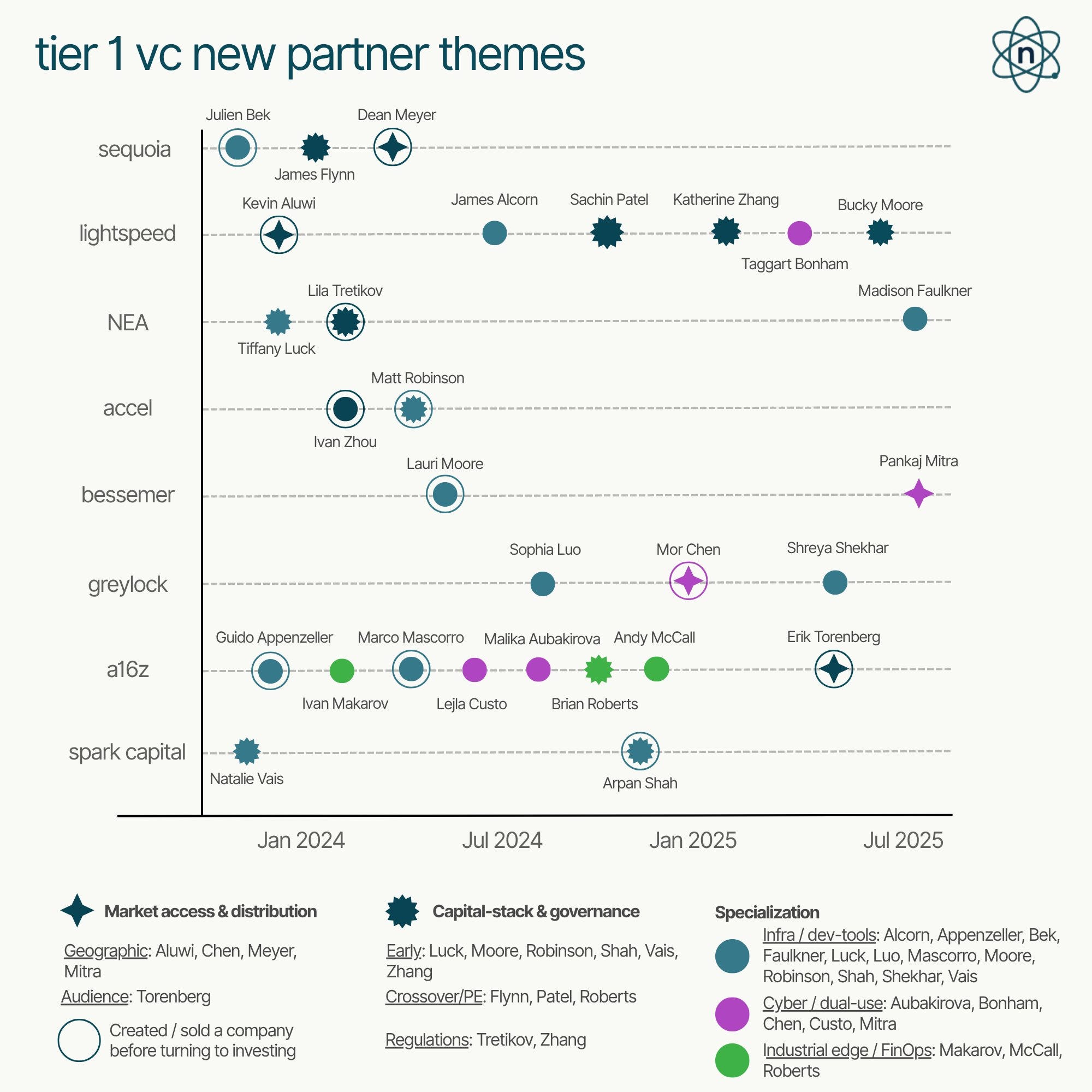
(1) New Partner DNA at the Top Firms
Infrastructure/dev-tools dominates with 11 new partners across firms, signaling strong VC focus on technical evaluation talent for developer-focused investments.
Cyber/dual-use hiring concentrated in mid-2024 across multiple firms (Aubakirova, Bonham, Chen, Custo, Mitra), reflecting increased interest in security and defense-tech.
a16z leads expansion with 8 new partners spanning multiple specializations, while most other tier 1s added 2-3, revealing a significantly more aggressive growth strategy.
Several new partners previously founded/sold companies (hollow circles), bringing operational credibility to investment decisions.
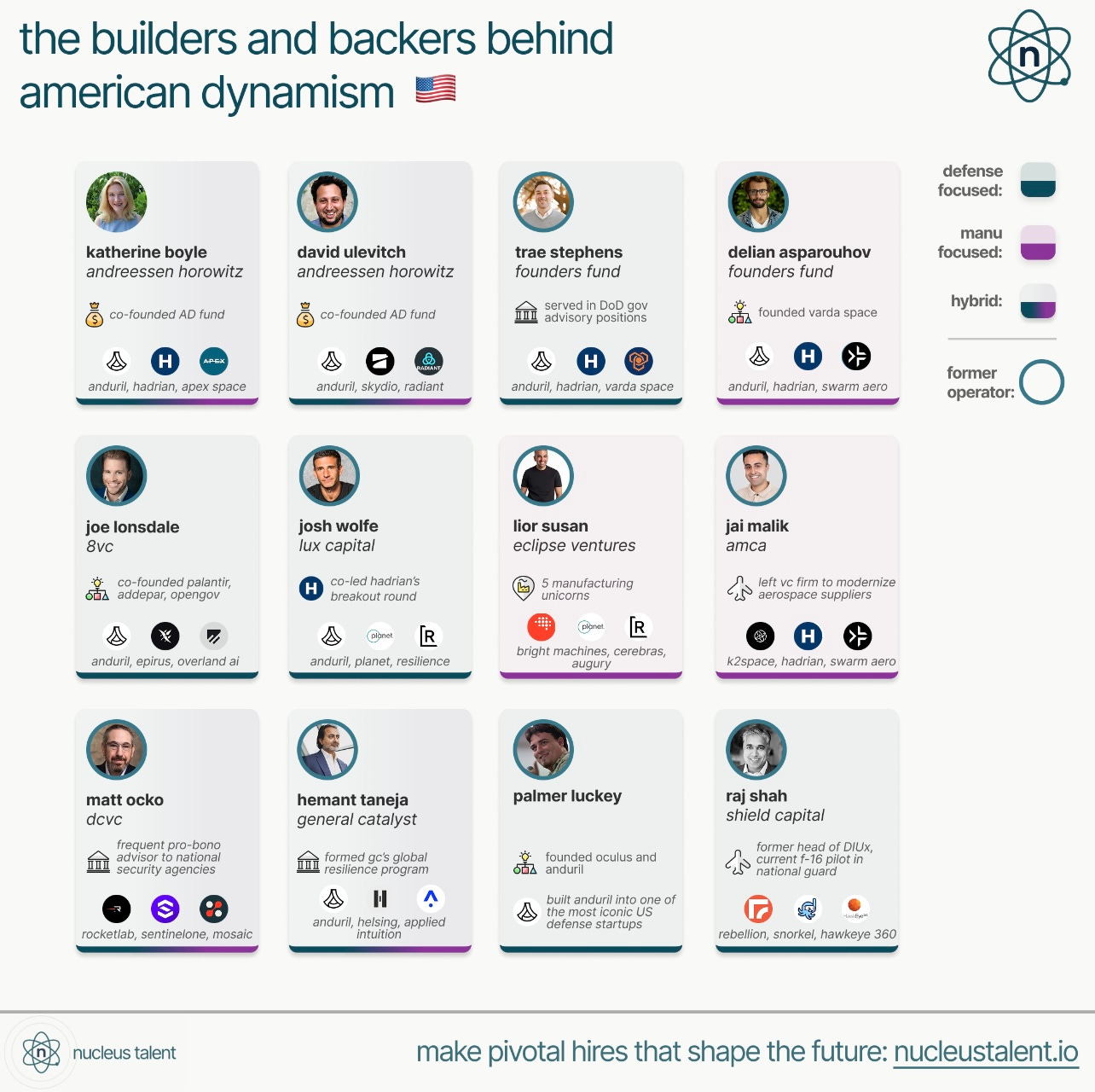
(2) American Dynamism Architects
Anduril appears in 8 of 12 portfolios shown, establishing itself as the most widely-backed company among this defense/manufacturing investor cohort.
11 of 12 investors are former operators, bringing direct company-building experience to their investment roles in American Dynamism sectors.
Hadrian appears in 4 portfolios, making it the second most popular investment after Anduril among these manufacturing and defense-focused backers.
Most investors show hybrid focus combining defense and manufacturing bets, with Stephens being the only pure defense-focused investor (with a government advisory background).
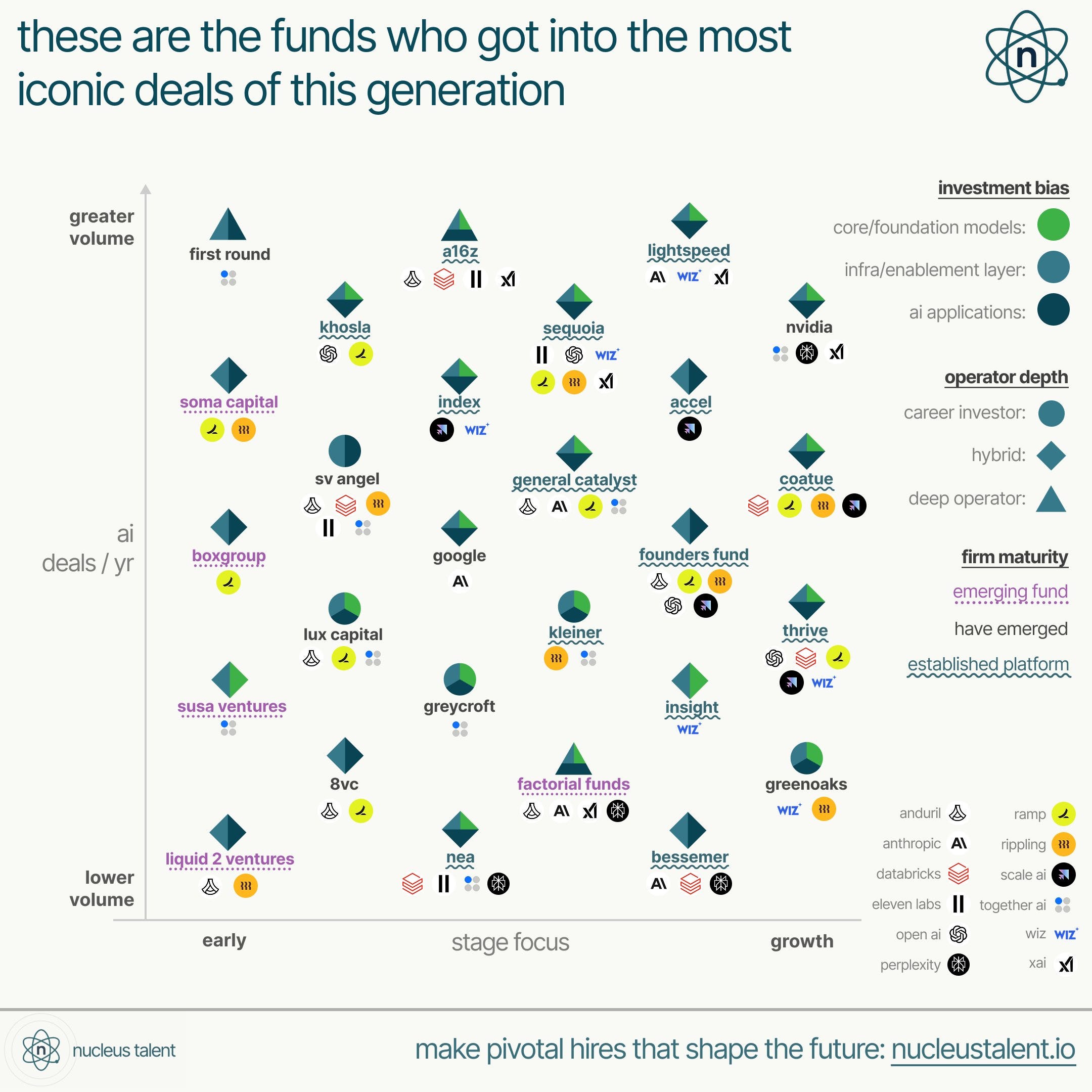
(3) The Firms Behind Iconic Outcomes
First Round, a16z, and Lightspeed achieved the highest volume of iconic AI deals, with First Round and a16z focused on earlier stages while Lightspeed spans early to growth.
Deep operator funds (triangles) like First Round, a16z, and Factorial Funds punch above their weight in deal access despite varying investment volumes, suggesting operator networks provide unique sourcing advantages.
Ramp, Anthropic, and Scale AI emerge as the most commonly backed companies across this cohort, appearing in multiple fund portfolios and spanning different stage focuses.
Emerging funds like Soma Capital and Boxgroup secured access to multiple iconic deals despite lower overall volumes, demonstrating that firm maturity isn’t a prerequisite for top-tier deal flow.
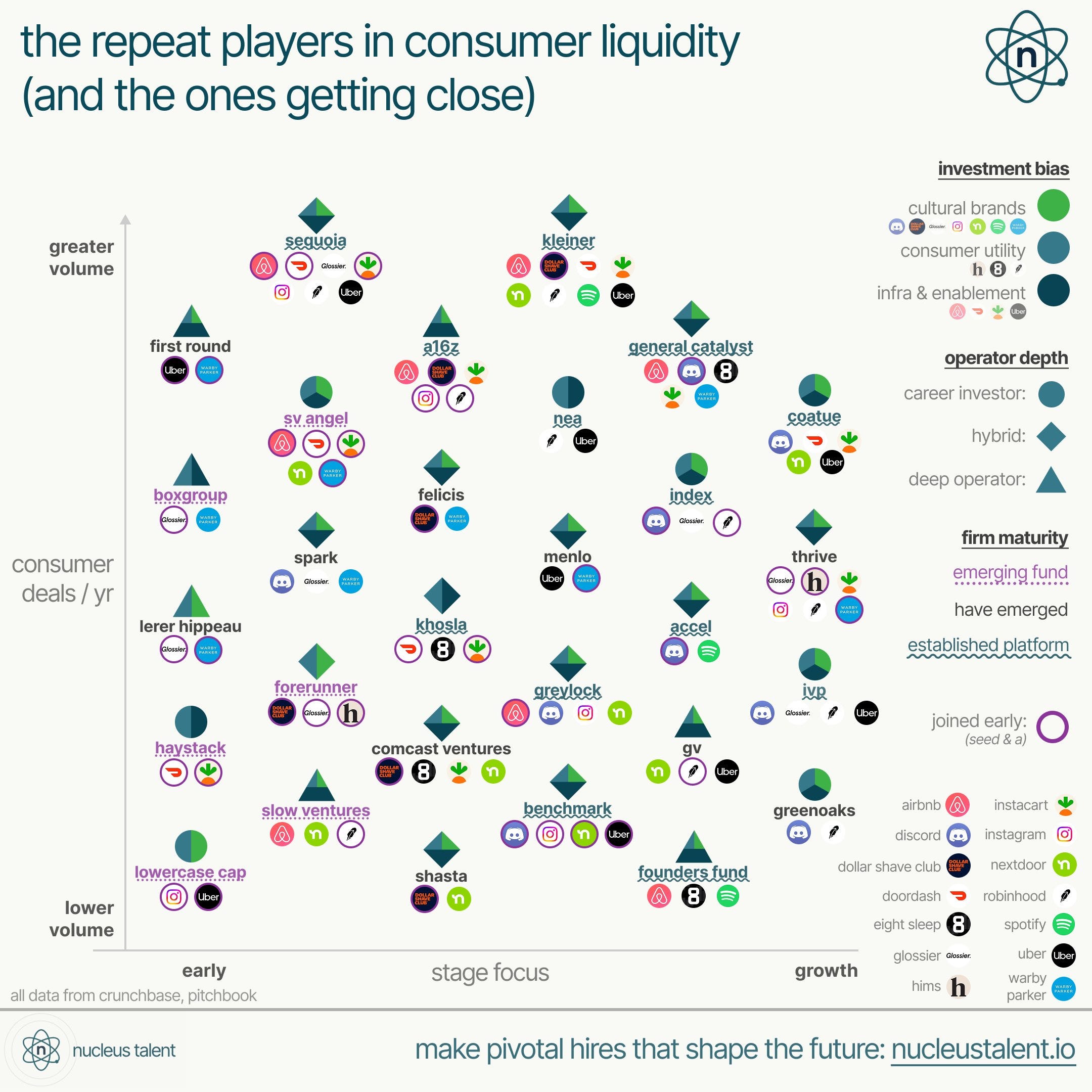
(4) Consumer Liquidity Engines
Airbnb, Discord, and Instacart appear most frequently across portfolios (8+ funds each), establishing themselves as the most widely-backed consumer companies among repeat liquidity providers.
Deep operator funds (triangles) like First Round, a16z, GV, Slow Ventures, and Founders Fund dominate deal volume, suggesting operator networks are particularly valuable for consumer company access.
Sequoia and Kleiner lead in consumer deal volume at the high end, while maintaining diverse portfolios spanning cultural brands, utilities, and infrastructure - indicating generalist platforms at scale.
Several emerging funds (Lowercase Cap, Lerer Hippeau, Haystack) secured early positions in multiple consumer winners despite lower overall volumes, demonstrating strong early-stage consumer picking ability.
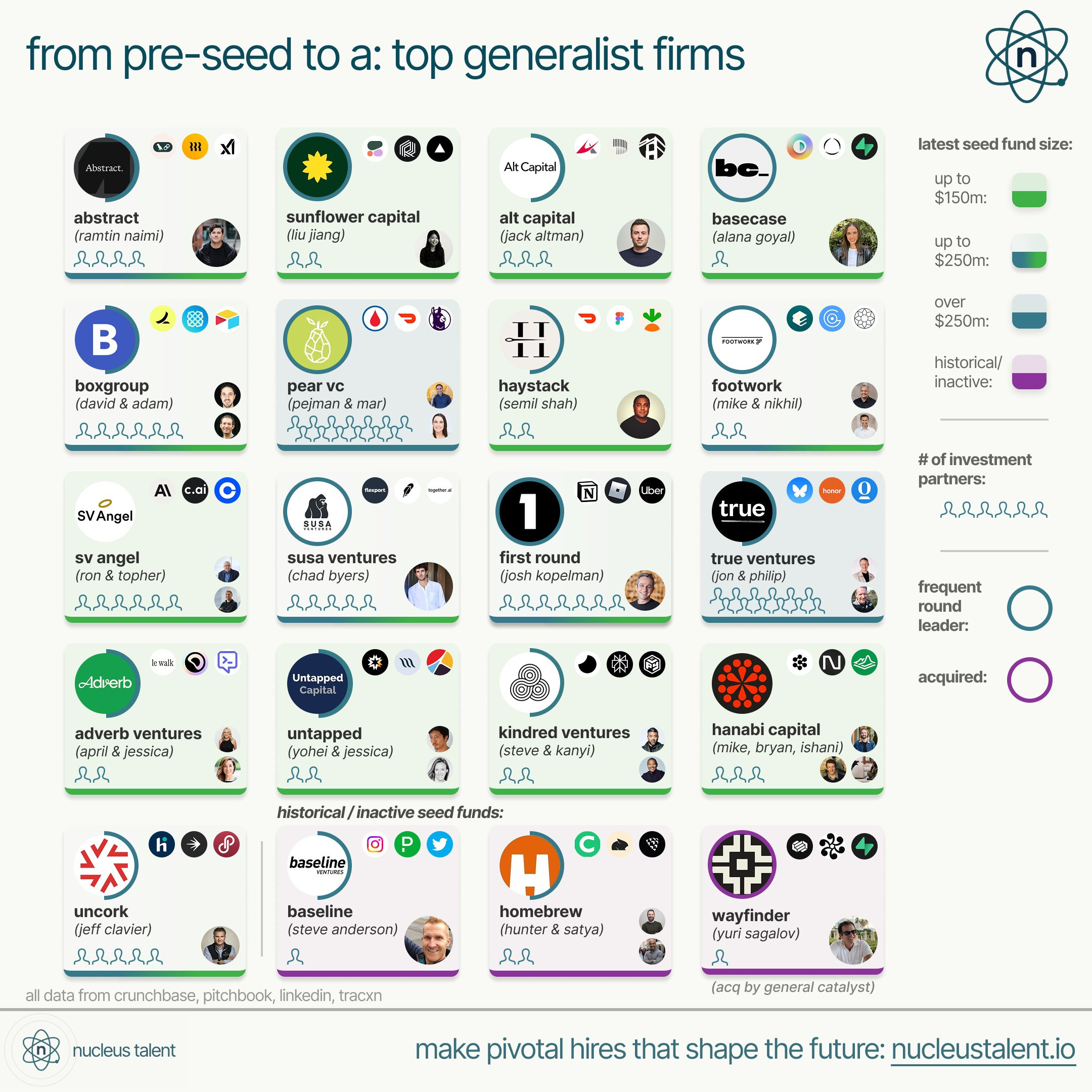
(5) Pre-Seed to Series A Generalist Leaders
Pear VC and True Ventures lead in team size with 10+ investment partners each, while maintaining active seed portfolios, suggesting larger partnership models for generalist early-stage firms.
Three firms (Baseline, Homebrew, Wayfinder) are marked as historical/inactive, representing a shift in the pre-seed to Series A landscape as founding-era funds wind down or get acquired.
Most active firms cluster around 2-6 partners, with the $150m-$250m fund size range being most common, indicating this as the sustainable scale for generalist seed investing.
Six firms show frequent round leadership (teal circles) - Sunflower, Basecase, Pear, Footwork, Susa, and First Round - differentiating themselves as lead investors rather than syndicate participants.
If you enjoyed this, Part 2 drops in a week! Stay tuned by following our twitter, and expect more great insights in 2026.
Great visual breakdown of the VC power structure. The new partner DNA at top firms chart especially caught my eye, basically maps the nucleas of where institutional capital flows. I've been tracking how these partner moves often preceed sector rotations by 12-18 months, kinda like watching tectonic plates shift before the landscape changes.